
Alopecia Areata is a more distinctive form of hair loss. Here, spontaneous bald patches appear on both the head and body, where the patches often occur in circular shapes, which is why the condition also goes by
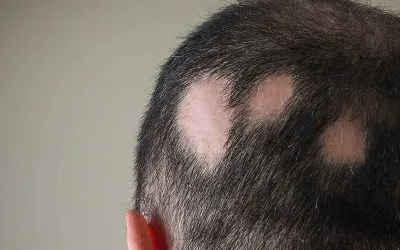
Alopecia Areata is a more distinctive form of hair loss. Here, spontaneous bald patches appear on both the head and body, where the patches often occur in circular shapes, which is why the condition also goes by
Alopecia Areata is a more distinctive form of hair loss. Here, spontaneous bald patches appear on both the head and body, where the patches often occur in circular shapes, which is why the condition also goes by the name patchy hair loss. The condition is relatively common and is found in around 1.7% of the population. If the condition worsens and suddenly all the hair on the head is lost, the condition is termed Alopecia Totalis, and if it worsens to the point where all the hair on the entire body is lost, Alopecia Universalis is used to describe the condition.
Unfortunately, this development is often seen in people who have first developed patchy hair loss. However, there are a number of recognised treatment options for patchy hair loss, which are reviewed below.
The specific cause of patchy hair loss is still uncertain, but it is assumed that there is a strong genetic predisposition, and the condition also falls under the category of autoimmune conditions.
The reason for this is that the hair loss in patchy hair loss is caused by many of the hair follicles spontaneously, and earlier than intended, entering a resting phase known as the telogen phase. In the resting phase, the follicles close, which is why the hair no longer has the ability to grow out. Since the specific triggers for patchy hair loss are not yet known, its onset can be difficult to stop.
There are several factors that are believed to be linked to the onset and development of patchy hair loss; however, the connection is uncertain and difficult to establish. These factors include both environmental and genetic factors and involve, among other things:
Trauma that affects the immune system or head injuries has been shown to be a potential trigger for patchy hair loss.
In some people with patchy hair loss, the seasons can even cause fluctuations in the disease.
In people who are susceptible to developing patchy hair loss, the condition can develop in connection with wounds, scratches and other injuries to the scalp.
This is also seen during pregnancy in women
There is an increased familial occurrence of the disease, especially with early onset.
Since viruses and bacteria also affect the immune system, these are also assumed to potentially be involved in the development of patchy hair loss.
Depending on how extensive the condition is and what stage it has reached, treatment of patchy hair loss can be enormously effective. If the condition has reached the point of affecting the entire head or the entire body, as with Alopecia Totalis and Alopecia Universalis, treatment becomes more difficult. However, spontaneous recovery is seen in up to 80% of all people who have previously suffered from Alopecia Areata, which is why it is in many ways a condition that is difficult to make sense of. Treatment can involve both local treatment with steroid injections as well as clinical treatment of hair loss with stimulating treatments.
Book a free 15-min consultation — no obligations, just an honest assessment of your situation and options.