
The disease alopecia, which causes hair loss, actually involves three different types (Universalis, Totalis and Areata).
The disease alopecia, which causes hair loss, actually involves three different types (Universalis, Totalis and Areata).
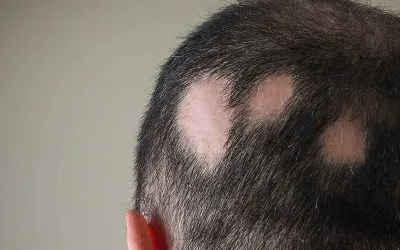
The disease alopecia, which causes hair loss, actually involves three different types (Universalis, Totalis and Areata). The most widespread type is Alopecia Areata, which also goes by the name patchy hair loss.
Here, the hair loss occurs as spontaneous, circular patches on the scalp and can also involve the body. If this condition develops to encompass complete baldness on the head, the condition is termed Alopecia Totalis, and if the condition involves hair loss across the entire body, it is termed Alopecia Universalis.
These two forms of hair loss are seen somewhat more rarely than the related Alopecia Areata. All forms of alopecia fall under the category of autoimmune diseases, in which the body's own immune system turns against the hair follicles.
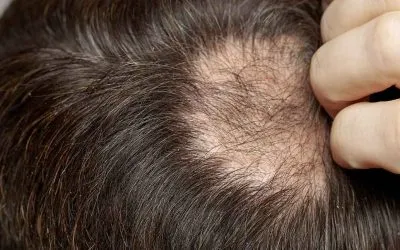
This autoimmune condition will over time lead to complete hair loss. Alopecia Totalis involves only the hair on the head, and the condition will most often only lead to loss of hair on the crown, thereby resulting in baldness. However, in rarer cases it happens that the hair loss also involves facial hair, including eyelashes and eyebrows. Sometimes it can also happen that the condition affects nails as well as hair, where the nails become thinner and more fragile, so that they break more easily.
The condition often has an early onset, and people with Alopecia Totalis will usually have experienced the development before they reach the age of 40. Like other forms of hair loss, Alopecia Totalis also has a genetic component, which is why there is an increased likelihood that the condition is passed on to children. However, it has also been seen in rare cases that the condition can be caused by chronic stress or sudden trauma and shock states. With Alopecia Totalis, there is a higher incidence in men than in women; why this is the case is not known. In very rare cases, it has previously been seen that people with Alopecia Totalis experience a spontaneous recovery.
Although it is a difficult condition to treat, a dermatologist can often help if eyelashes and eyebrows have been lost. When treating hair loss, the focus is most often on calming the immune system so that it no longer attacks the follicles' hair production.
Alopecia Universalis is the rarest and at the same time the most severe type of all the different alopecia conditions. With this disease, the hair loss worsens so much that over time it develops from involving only hair on the head to also encompassing the body. People with this form of alopecia hair loss are born with a genetic mutation that sometimes varies in its time of onset.
The genetic mutation causes complete hair loss both on the head, as with Alopecia Totalis, as well as complete hair loss across the entire body. With this form of hair loss, the body is so strongly affected that the nails too become damaged and deformed. Alopecia Universalis is enormously difficult to treat, and although there are some well-developed methods, these do not have very high success rates.
An effective treatment is immunotherapy, where an allergic reaction on the skin helps to shock the hair follicles into resuming hair production. However, this treatment is only effective for as long as it lasts.
Book a free 15-min consultation — no obligations, just an honest assessment of your situation and options.